
 Bryan Potzner
In This Article 8 sections
- How a DMS handles one customer across a full year
- The same year on spreadsheets and a carbon pad
- How a DMS differs from a CRM and from accounting software
- Why car dealership software breaks on boats
- Which departments use a DMS every day
- Where a marine DMS runs and what it needs
- What a dealer management system costs
- Do you need a dealer management system yet
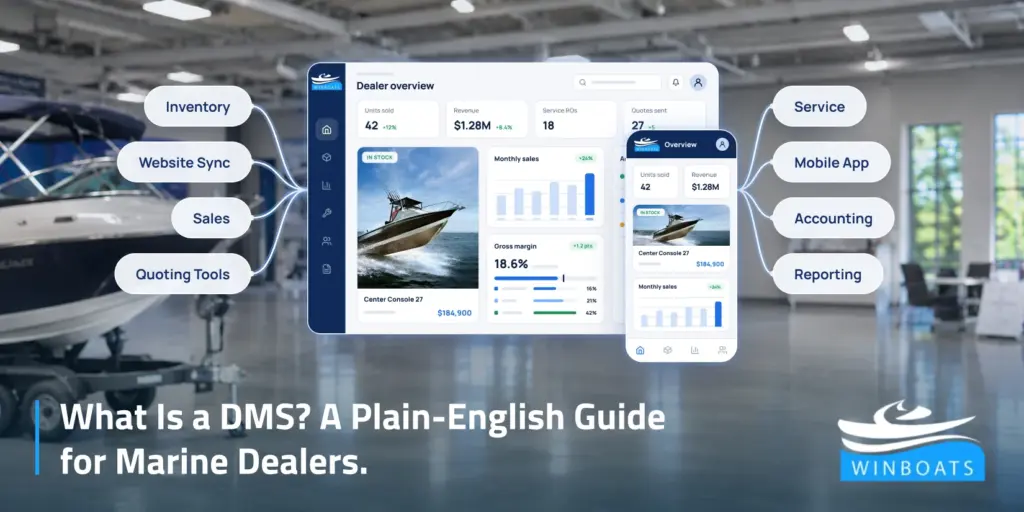
DMS stands for dealer management system. It’s one piece of software holding your customers, your boats, your parts, your work orders and the money moving through all of it, so that every department is reading the same records instead of keeping its own.
That’s the definition. It doesn’t tell you much.
What tells you something is watching where the information goes on a normal Tuesday. So here’s one customer across one year at a dealership that runs on one, and then the same year at a dealership that doesn’t. If you’re further along than this and already comparing systems, the buyer’s guide is the better place to start.
How a DMS handles one customer across a full year
May. A guy walks in and buys a pontoon.
Somebody quotes it off the price book, adds the rigging, works a number on his old bowrider and prints a buyer’s order. That paperwork creates a customer record and a unit record, and from then on the two are tied together. The boat leaves the lot, so your floor plan drops, your aged inventory list gets one unit shorter, and what the rigging actually cost you is sitting on the deal instead of in somebody’s head.
July. He calls about a noise.
Your writer opens a work order against that same boat, which means the hull number and both engine serials are already on the ticket. Nobody’s squinting at a photo of a transom.
The tech pulls the job, finds a chewed impeller, and the counter looks the part up in the Yamaha catalog without opening a browser or retyping a number. It’s in the second bin at the back counter. On the work order it goes, stock drops by one, and the part and the labor are now on the same ticket where the invoice can find them.
Then it turns out the engine’s still covered, and that’s the moment a lot of setups make you start the ticket over. On a work order that already carries warranty, retail, internal and dealer pricing, you switch the price level and accounting follows it, and the claim details stay on the record for November, when the manufacturer asks a question about it.
October. He’s back at the counter for a cover.
The sale rings up, stock drops, and it lands on his history next to the boat and the service job. Nobody had to remember to write it down a second time.
January. You want to know what that boat actually made you.
The deal, the rigging, the service work, the parts margin and the counter sale all hang off two records, so the answer takes about a minute. More to the point, you can ask the same question about every unit you moved last year without three people exporting spreadsheets and arguing about whose is right.
That’s the whole idea. Sales and prospecting, service and work orders, parts and inventory, boat inventory and point of sale on one database, with transactions going out to QuickBooks line by line and your boat inventory feeding the website.
The same year on spreadsheets and a carbon pad
Nobody’s running on nothing. The stack grew one piece at a time and every piece of it made sense the day it arrived.
QuickBooks has the money. A spreadsheet has the boats. Parts is a second spreadsheet, or it’s in your parts manager’s head, which works beautifully right until the week he’s in Florida.
Work orders are a carbon pad. Leads live in an email folder and a notebook in somebody’s truck.
And it holds for a while. Plenty of dealerships ran exactly like that for years and did well on it, right up to the point where the volume outgrew the setup.
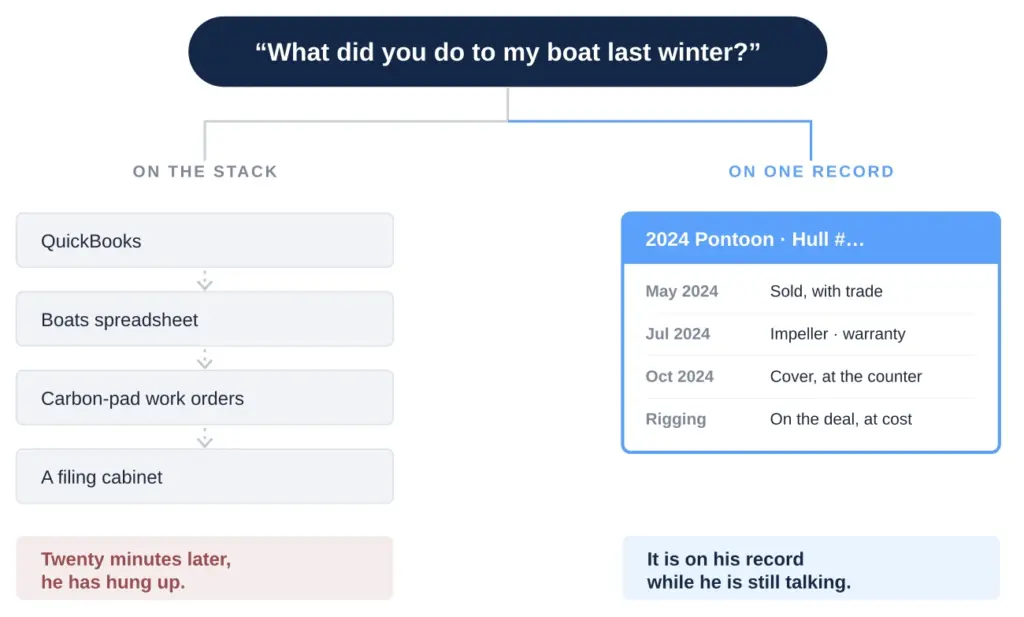
Where it gives out is that July phone call. The guy wants to know what you did to his boat last winter and whether the impeller was part of it, and the answer is in a filing cabinet twenty feet from the person holding the phone. The information exists. It’s just nowhere near the question, and by the time somebody digs it out he’s off the line and calling the shop across the lake instead.
The other failure is quieter. Type a part number into two places and eventually the two places disagree, and now nobody trusts either one. You end up walking out to the lot to count boats you already have a list of.
See Winboats In Action
Give us 30-60 minutes and our team will walk you through the tools behind this article.
How a DMS differs from a CRM and from accounting software
These three get tangled together in vendor conversations, and it’s how dealers end up paying for two of them and still not being able to see the shop.
| Software | What it holds | What it doesn’t |
|---|---|---|
| CRM | Leads, follow-ups, every conversation with a buyer before and after the sale. | Parts, work orders, boat inventory, money. |
| Accounting software | General ledger, payables, receivables, payroll, your financial statements. | What’s on the lot, what’s in the bay, what’s on the shelf. |
| DMS | The working records for every department, usually with a CRM built into it. | Your books. Most dealers keep QuickBooks running right alongside. |
That last row is the one to press a salesperson on. A dealer management system doesn’t replace your accountant and it doesn’t replace your general ledger. Winboats exports complete transaction data to QuickBooks line by line rather than one batch total at close of day, which is worth having your bookkeeper test on a demo rather than take anyone’s word for.
If all you need today is a tidy CRM and a clean QuickBooks file, that’s worth working out early rather than after four demos. Most dealerships do reach the point where the records need to live together, and the question turns out to be when rather than whether.
Why car dealership software breaks on boats
Most of what’s written about dealer management systems was written for car lots, which is why reading it gets you a list of modules that don’t quite describe your building. Five things about selling and fixing boats don’t fit that shape.
A boat deal carries four serial numbers
Car systems are built around the assumption of one serial number per sale. Everything else in this section follows from that one not being true for you.
The same part number sits on four shelves
Not one shelf. The main counter, the service bay and the satellite store all stock the same filter, and the only question that matters at 4pm is which of them has it right now. Winboats carries four bin locations per part number along with supersessions and three years of sales history, because “we had one of those” is not an answer anybody can act on.
Parts catalogs have to be marine catalogs
Yamaha, Mercury and Land ‘N’ Sea catalogs import into the system so your counter looks a part up in one place. A system that imports car catalogs beautifully does nothing for you at all.
One repair job can need four price levels
Warranty, retail, internal and dealer pricing on the same work order, switchable without rewriting the ticket. Jobs change halfway through. A customer-pay diagnosis turns into a warranty claim, or half of it does, and the system either handles that in one click or it costs your writer twenty minutes and an argument with accounting.
A marine year runs on a twelve-week season
April is chaos and January is quiet, and no car dealership works that way. MRAA’s monthly numbers put the average repair at US dealers at 56 days in February 2026 and 28 days by July, which is the same shops running at two completely different speeds six months apart. Scheduling against available tech hours rather than number of boats is what gets you through spring commissioning, and that only works if the hours are somewhere you can see them.
Which departments use a DMS every day
The thing worth knowing is that this isn’t a reporting tool the owner opens on Fridays. It’s the screen your people live in all day, which changes what matters when you pick one.
Your writer has it open from the time the doors unlock. The parts counter has it open during every phone call. Techs are in it on the bay floor, salespeople are in it with a customer sitting across the desk, and whoever does your books is in it at month-end wondering why one number looks odd.
Which is exactly why rollouts fail when they fail. If the counter decides it’s easier to keep the old notebook, every number downstream is wrong and you’ve bought a very expensive spreadsheet. The feature list matters much less than who trains your staff, when, and what happens in week three after everyone’s forgotten. Winboats ships a video library split by dealership role plus one-on-one sessions, and the role split is the part that counts, because a parts manager and a service writer need almost nothing in common.
Where a marine DMS runs and what it needs
Usually asked as “is it cloud?” Two setups are normal. The system sits on a server in your building, or it’s hosted for you and your people connect to it. Winboats does both, on Windows either way. What changes is who owns the box, who’s responsible for backing it up, and what your afternoon looks like when the internet goes down during boat show season.
Ask which one you’re being sold, because it moves your IT costs and your disaster plan. A dealer with a solid server and a flaky connection wants one answer. A three-store group with nobody on staff who likes computers wants the other.
What a dealer management system costs
Most marine vendors don’t publish pricing and Winboats is among them. The reason given is that it depends on locations, users and how much setup and conversion you need, so no published number would mean anything until somebody has looked at your dealership.
Worth knowing what moves it before you ask: how many locations, how many people need to log in, which parts of the system you turn on, and what shape your current data is in. A single store with clean records and a four-store group carrying twenty years of history out of a system nobody supports anymore are not remotely the same project, and the second one costs more in setup than in software.
Do you need a dealer management system yet
It comes down to how often the gaps are costing you, and that’s easier to work out than it sounds.
If you’re one location moving a handful of boats a year, with a tidy QuickBooks file and a parts shelf you can see from the counter, you’ve got some runway. What to watch for is the point where the gaps start taking real money out of the year, and it shows up as the same five things every time:
- The same information gets typed into more than one place.
- Nobody can tell you what’s on the lot without walking outside.
- Parts arrive and nobody’s sure which boat they were for.
- Last winter’s work on a boat means opening a filing cabinet.
- Month-end takes days and the numbers still get argued about.
Two or three of those sounding familiar is usually where dealers start looking, and it’s the right time to look rather than the week something breaks. The next question is what a move actually takes in data, training and timing, which is worth understanding before a demo rather than after. If you want to walk through what that would look like for your dealership, we’re happy to go through it with you.
Put This Into Practice With Winboats
Bryan Potzner
Bryan Potzner developed Winboats while running his own Malibu boat dealership in Atlanta, after finding that no dealer management system was built for the way boat dealers work. Today he and his team help marine dealerships run sales, service, parts and accounting in one system.
View All Articles By Bryan Potzner

